
In the 1970s and '80s a wave of industrialization contributed to the greatest political and social mobilization in South African history, of which the trade-union movement was one of the central driving forces.
Notebooks
No.26 The Trade-Union Left and the Birth of a New South Africa
 by Claude Jacquin - 92 pages€5,00
No.24-25 World Bank/IMF/WTO: The Free-Market Fiasco
 by Susan George, Michel Chossudovsky et al. OUT OF PRINTNot available
The International Monetary Fund, World Bank and World Trade Organization have managed to impose neo-liberal policies on virtually the entire world.
No.23 Lean Production: A Capitalist Utopia?
 by Tony Smith - 68 pages€5,00
No.22 Women's Lives in the New Global Economy
 by Penny Duggan & Heather Dashner (editors) - 68 pages€5,00
Women's Lives in the New Global Economy links together transformations that are affecting women in factories and farms, as peddlers and professionals, as neighbours, mothers and wives, in old age and even in the womb.
No.21 Factory Commitees and Workers' Control in Petrograd in 1917
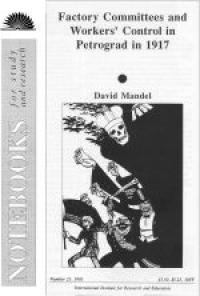 by David Mandel - 48 pages€5,00
Factory Committees and Workers' Control in Petrograd in 1917 tells the story of 1917 'from below', delving into Russian-language archives to uncover worker-activists' own words. Petrograd workers did not dream at first of 'socialist experiments' in backward Russia.
No.19-20 The Fragmentation of Yugoslavia: An Overview
 by Catherine Samary - 60 pages€5,00
The Fragmentation of Yugoslavia is a comprehensive report on the Yugoslav tragedy: a historical overview; a multi-disciplinary social study; an invitation to collective reflection; and a call for solidarity with those working for peace with justice for all the ex-Yugoslav communities.